

Not long ago, joint pain was considered a problem of older age. Today, orthopaedic clinics are seeing a steady rise in young adults, many in their twenties and thirties, complaining of knee pain, stiff shoulders, and aching backs. This shift is not a coincidence. It reflects how modern lifestyles, work habits, and physical activity patterns are quietly reshaping joint health at a much earlier stage of life.
Joint pain in young adults is no longer an occasional complaint. It is becoming a recurring concern that affects productivity, sports performance, and quality of life. Ignoring it often leads to long-term joint damage that could have been prevented with timely attention.
This article explains why joint pain is increasing among younger people, what causes it, which warning signs deserve medical attention, and how you can protect your joints for the decades ahead.
Why Joint Pain Is Becoming More Common in Young Adults
A few decades ago, joint complaints among people under 40 were largely linked to injuries or rare genetic conditions. The picture has changed considerably.
Several overlapping factors are driving this trend:
- Longer hours spent sitting at desks or in front of screens
- Increased participation in high-intensity sports without proper conditioning
- Rising rates of obesity and metabolic conditions in younger populations
- Greater awareness, which means more people now report pain instead of ignoring it
- Higher screen time leading to poor posture from an early age
Joint pain in young adults often develops gradually. It may begin as mild stiffness after a workout or a long day at a desk, then slowly progress into persistent discomfort that interferes with daily movement. Recognising this pattern early is one of the most effective ways to prevent long-term joint damage.
Common Causes of Joint Pain in Young Adults

There is rarely a single cause behind joint pain in younger people. It usually results from a combination of physical stress, lifestyle habits, and sometimes underlying medical conditions.
Sports Injuries and Exercise-Related Joint Problems
Athletes and fitness enthusiasts are among the most common groups affected by joint pain. Repetitive movements in sports like running, football, badminton, and weightlifting place continuous stress on the knees, shoulders, and ankles.
Common sports-related joint issues include:
- Ligament sprains and tears, particularly ACL injuries in the knee
- Meniscus tears from twisting movements
- Tendinitis in the shoulder, elbow, or knee from overuse
- Cartilage wear from high-impact training without adequate recovery
Many young athletes push through pain, assuming it will resolve on its own. This approach frequently worsens the underlying injury and can lead to chronic joint instability later in life.
Sedentary Lifestyle and Poor Posture
Ironically, inactivity contributes just as much to joint pain as overexertion. Long hours of sitting weaken the muscles that support the joints, particularly around the knees, hips, and spine.
Poor posture while working on laptops or phones places uneven stress on the neck, shoulders, and lower back. Over time, this can lead to stiffness, muscle imbalances, and joint discomfort that may seem unrelated to any specific injury.
Obesity and Excess Stress on Joints
Excess body weight significantly increases the mechanical load on weight-bearing joints, especially the knees and hips. Research has shown that every extra kilogram of body weight can multiply the force exerted on the knee joint several times over during walking and climbing stairs.
This added stress accelerates cartilage wear, making obesity one of the strongest modifiable risk factors for early-onset knee pain in young adults.
Nutritional Deficiencies Affecting Joint Health
Joint tissues depend on adequate nutrition to repair and maintain themselves. Deficiencies in vitamin D, calcium, and omega-3 fatty acids are commonly seen in young adults, particularly those with limited sun exposure or poor dietary diversity.
Low vitamin D levels have been linked to increased musculoskeletal pain and weaker bone density, which indirectly affects joint stability and comfort.
Early-Onset Arthritis and Inflammatory Conditions
While arthritis is generally associated with older age, certain forms can appear much earlier in life. Conditions such as rheumatoid arthritis, psoriatic arthritis, and ankylosing spondylitis often begin in the 20s and 30s.
These inflammatory conditions cause joint swelling, morning stiffness, and pain that does not improve with rest, distinguishing them from mechanical or activity-related joint pain. Early diagnosis is essential, as untreated inflammatory arthritis can cause permanent joint damage.
Risk Factors That Increase the Likelihood of Joint Pain
Certain factors make some individuals more prone to developing joint pain at a younger age:
- Family history of arthritis or autoimmune conditions
- Previous joint injuries that were inadequately rehabilitated
- Jobs requiring repetitive movements or prolonged standing
- Lack of regular physical activity or, conversely, excessive high-impact training
- Smoking, which reduces blood flow to joint tissues
- Poor sleep quality, which affects the body’s natural inflammatory response
- Hormonal factors, which can influence ligament laxity and joint stability
Understanding these risk factors allows young adults to take preventive action before symptoms become severe.
Early Joint Pain Symptoms and Warning Signs That Require Medical Attention
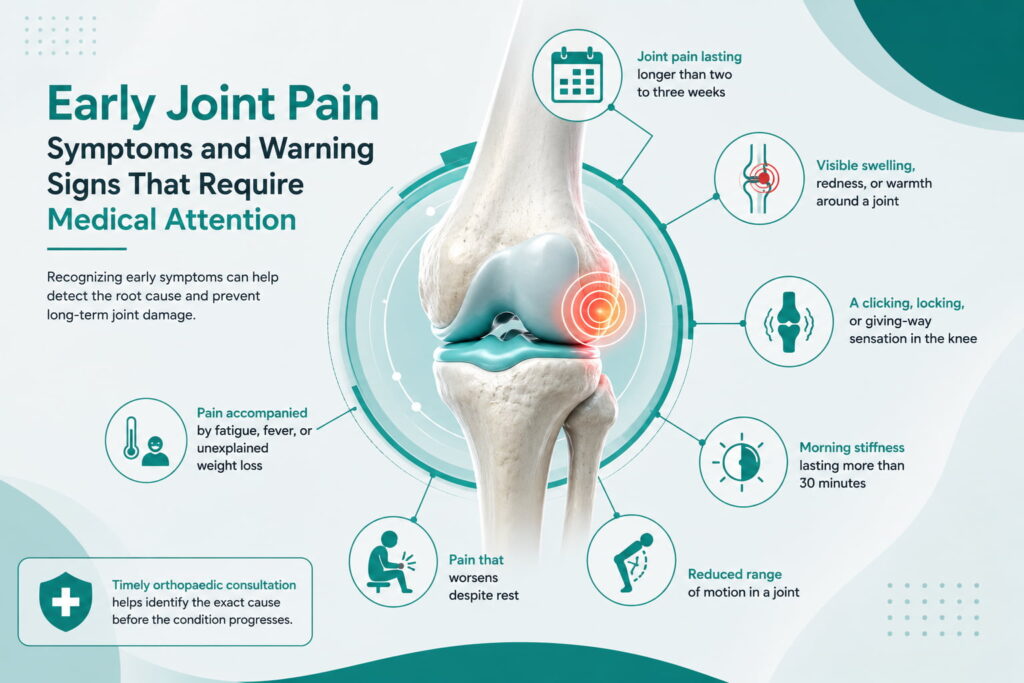
Not all joint discomfort needs urgent care, but certain symptoms should never be ignored.
Seek medical evaluation if you experience:
- Joint pain lasting longer than two to three weeks
- Visible swelling, redness, or warmth around a joint
- A clicking, locking, or giving-way sensation in the knee
- Morning stiffness lasting more than 30 minutes
- Pain that worsens despite rest
- Reduced range of motion in a joint
- Pain accompanied by fatigue, fever, or unexplained weight loss
These early joint pain symptoms can indicate anything from a minor soft tissue injury to an underlying inflammatory disorder. A timely orthopaedic consultation helps identify the exact cause before the condition progresses.
Effective Prevention Strategies for Maintaining Healthy Joints
Preventing joint pain is far more manageable than treating advanced joint damage. The following strategies form the foundation of long-term joint health.
The Role of Exercise, Strength Training, and Mobility Work
Movement is essential for joint health, but the type and quality of movement matter just as much as the quantity.
Effective approaches include:
- Strength training to build muscle support around joints, particularly the quadriceps and glutes for knee protection
- Low-impact cardiovascular exercise such as swimming or cycling to maintain joint mobility without excessive strain
- Mobility and flexibility routines to preserve range of motion
- Gradual progression in training intensity to avoid overuse injuries
- Proper warm-up and cool-down routines before and after physical activity
Strength training is particularly valuable because stronger muscles absorb impact that would otherwise be transferred directly to the joints.
Diet and Lifestyle Habits That Support Long-Term Joint Health
A joint-friendly diet focuses on reducing inflammation and supporting tissue repair.
Helpful dietary habits include:
- Adequate protein intake to support muscle and connective tissue repair
- Omega-3 rich foods such as fish, walnuts, and flaxseeds to reduce joint inflammation
- Sufficient calcium and vitamin D for bone and cartilage support
- Maintaining a healthy body weight to reduce mechanical stress on joints
- Staying well hydrated, as cartilage relies on adequate fluid for cushioning
- Limiting excessive sugar and processed food intake, which can promote systemic inflammation
Lifestyle factors also play a meaningful role. Improving posture at workstations, taking regular movement breaks, ensuring quality sleep, and avoiding smoking all contribute to healthier joints over time.
When to Consult an Orthopaedic Specialist
Many young adults delay seeing a specialist, hoping the pain will resolve on its own. While minor discomfort often improves with rest, certain situations call for professional evaluation.
Consider consulting an orthopaedic specialist if:
- Pain persists beyond a few weeks despite rest and home care
- There is visible swelling, instability, or deformity in the joint
- Pain interferes with daily activities, work, or sports performance
- You experience repeated episodes of the same joint pain
- Symptoms suggest an inflammatory or autoimmune condition
An orthopaedic specialist can accurately diagnose the underlying cause through clinical examination, imaging, and, where necessary, laboratory tests, allowing for a targeted treatment plan rather than guesswork.
Treatment Options Available for Young Adults With Joint Pain
Joint pain treatment for younger patients is generally focused on preserving joint function and avoiding long-term damage, rather than jumping straight to surgical solutions.
Common approaches include:
- Physiotherapy and rehabilitation: Targeted exercises to restore strength, stability, and mobility around the affected joint
- Activity modification: Adjusting training routines or work ergonomics to reduce repetitive joint stress
- Medication: Anti-inflammatory medications for short-term pain and swelling control
- Bracing or support devices: Useful for ligament injuries or joint instability during recovery
- Minimally invasive procedures: Such as arthroscopy for diagnosing and treating certain ligament or cartilage injuries
- Disease-specific treatment: For inflammatory arthritis, this may involve specialised medication to control the underlying immune response
The right treatment depends entirely on an accurate diagnosis. This is why self-treatment based on generic advice often falls short, while a structured evaluation by a specialist leads to faster, more lasting relief.
Conclusion
Joint pain in young adults is a growing reality, shaped by sedentary routines, sports demands, weight-related stress, nutritional gaps, and sometimes underlying inflammatory conditions. The encouraging part is that most causes are either preventable or highly treatable when addressed early.
Paying attention to early joint pain symptoms, maintaining a strength-focused exercise routine, supporting your body with proper nutrition, and correcting posture habits can protect your joints for decades to come.
If you are experiencing persistent knee pain, stiffness, or any joint discomfort that does not improve with rest, it is worth getting evaluated rather than waiting for it to worsen. Dr. Kshitij Mody, an experienced orthopaedic specialist, can help identify the exact cause of your joint pain and guide you toward the most effective treatment plan suited to your lifestyle and activity level. Early evaluation today can mean healthier, pain-free joints for years ahead.