
How Long Does an Artificial Knee Last?
If you are living with daily knee pain, this question is probably on your mind before any other: how long will an artificial knee actually last? It is a fair question. Knee replacement is a significant decision, and you want to know that the result will serve you for years, not just a few seasons.
The short and reassuring answer: a modern artificial knee lasts 20 to 25 years or more in most patients. Large national registry data show that roughly 9 out of 10 total knee implants are still working at 20 years, and over 8 out of 10 at 25 years. This guide explains what those numbers really mean, what makes one knee last longer than another, and what you can do to protect your implant.
Quick Answer: Artificial Knee Lifespan at a Glance
- Total knee replacement: about 93% still working at 15 years, about 90% at 20 years, and about 82% at 25 years.
- Partial (unicompartmental) knee replacement: about 76% at 15 years, about 72% at 20 years, and about 70% at 25 years.
- Typical expectation: 20 to 25+ years for a well-selected, well-implanted, well-cared-for knee.
- Biggest influences: your age and activity level, body weight, implant type, surgical accuracy, and how well you follow aftercare.
What the Research Says About Knee Replacement Longevity
The most reliable answer to this question comes from a large systematic review published in The Lancet in 2019. The researchers pooled data from national joint registries in countries such as Australia and Finland, covering nearly 300,000 knee replacements.
| Type of Knee Replacement | 15 Years | 20 Years | 25 Years |
|---|---|---|---|
| Total Knee Replacement | 93.0% | 90.1% | 82.3% |
| Partial (Unicompartmental) Knee Replacement | 76.5% | 71.6% | 69.8% |
These figures describe implant survival: the percentage of knees that had not needed revision surgery by that time. A few points are worth understanding:
- “Survival” does not mean “failure” for the rest. A knee that has not been revised can still feel imperfect, and a knee that was revised did not necessarily “break”. The studies count revision as the endpoint because it is the clearest, most measurable event.
- The data reflect implants placed decades ago. Materials, implant designs, and surgical planning have improved since then, so today’s patients may do as well or better. That is encouraging, but it cannot be proven until those implants have also completed 20 to 25 years.
- These are averages across thousands of patients. Your own result depends on the individual factors below.
If you want to understand the procedure itself before thinking about durability, our guide to total knee replacement surgery walks through how the operation is done and what to expect.
Why Does an Artificial Knee Eventually Wear Out?
An artificial knee is made of a metal alloy on the thigh bone and shin bone, with a medical-grade polyethylene (plastic) spacer between them that acts like cartilage. Every step you take puts a small amount of load on that spacer. Over many years, three things can limit an implant’s life:
- Wear of the plastic liner. Microscopic particles can gradually shed from the liner. Modern highly cross-linked polyethylene wears far less than older versions.
- Loosening. The bond between the implant and bone (cement or biological fixation) can weaken with time, especially with high loads or poor bone quality.
- Infection or instability. Less common, but important causes of early or late problems.
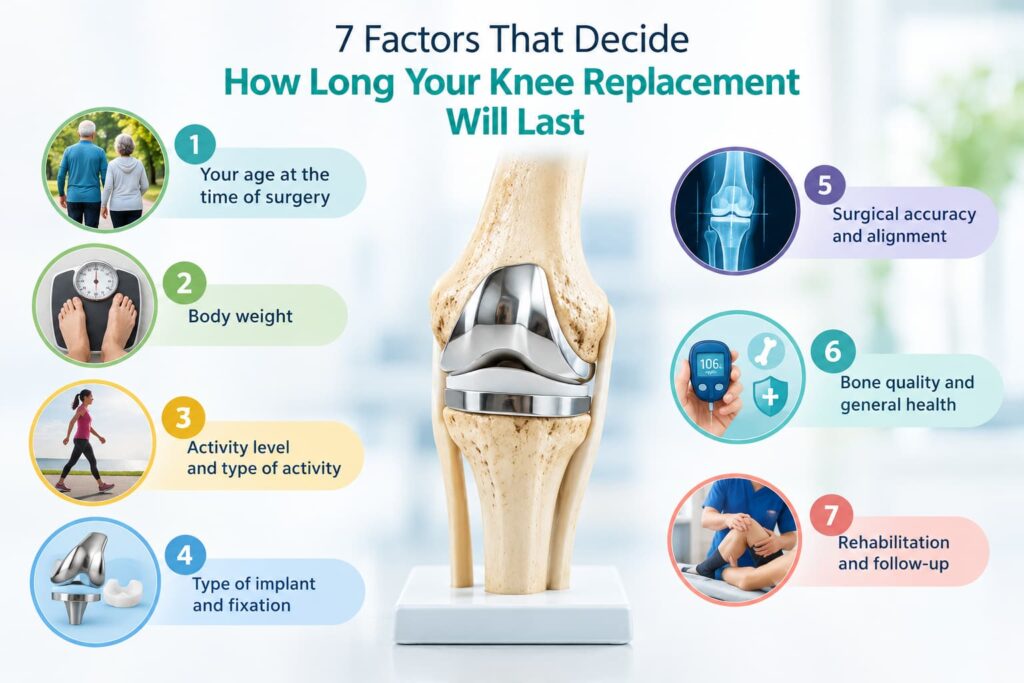
7 Factors That Decide How Long Your Knee Replacement Will Last
1. Your age at the time of surgery
Younger patients are more active and will simply live with the implant for longer, so they have a higher lifetime chance of needing a revision. A patient who has surgery at 70 may never need a second operation, while someone operated on at 50 might. This is one reason surgeons weigh timing carefully; our article on signs that it may be time for knee replacement explains how that decision is made.
2. Body weight
Every extra kilogram multiplies the load across the knee joint during walking and stairs. Higher body weight is linked with faster wear and a greater risk of loosening. Even modest weight loss before and after surgery meaningfully reduces strain on the implant.
3. Activity level and type of activity
The implant is built for everyday life and low-impact exercise. Walking, swimming, cycling, golf, and gentle gym work are generally encouraged. Repeated high-impact activity such as long-distance running, jumping sports, or heavy lifting increases wear. Staying active matters, since strong muscles protect the joint, but choosing the right kind of activity matters more.
4. Type of implant and fixation
Implant design, bearing material, and whether the implant is cemented or uncemented all play a part. Total knee replacements have the strongest long-term track record. For patients with damage limited to one compartment, a partial knee replacement can be a good option, though the registry data show partial replacements are more likely to need revision over time than total replacements. In return they preserve more of your natural knee and often feel more natural.
5. Surgical accuracy and alignment
Precise bone cuts, correct alignment, and good soft-tissue balance spread load evenly across the implant and reduce uneven wear. This is where planning technology can help. Computer-assisted and robotic-assisted knee replacement is designed to improve the precision of implant positioning. It is worth being honest that long-term studies proving longer implant life with robotics are still being gathered, but accurate positioning is a sound principle for durability.
6. Bone quality and general health
Conditions such as diabetes, osteoporosis, inflammatory arthritis, and poor circulation can affect healing, bone strength, and infection risk. Keeping these well controlled before and after surgery protects your result.
7. Rehabilitation and follow-up
Consistent physiotherapy rebuilds the muscles that support the knee, and regular check-ups with X-rays help your surgeon spot early wear or loosening before it becomes a problem. People who understand the recovery process tend to recover better, which is why it helps to read up on whether knee replacement is a major surgery and what recovery really involves.
Total vs Partial vs Revision Knee Replacement: Does Lifespan Differ?
Yes, to some degree.
- Total knee replacement replaces the whole joint surface and has the best-documented long-term durability.
- Partial knee replacement replaces only the damaged compartment. It suits a carefully selected group of patients and offers faster recovery and a more natural feel, with a somewhat higher long-term revision rate in registry data.
- Revision knee replacement is a second (or later) operation to replace a worn or loose implant. A revision knee replacement can restore function very successfully, though revision implants generally have a shorter expected life than a first implant, which is one more reason to take care of your first one.
Signs Your Artificial Knee May Need Attention
A healthy knee replacement is usually quiet and comfortable. See your orthopaedic surgeon if you notice:
- New or increasing pain, especially pain at rest or at night
- Swelling that keeps returning
- A feeling that the knee is loose, unstable, or “giving way”
- Growing stiffness or a limp that was not there before
- Redness, warmth, or fever around the knee, which can signal infection and needs urgent attention
A problem caught early is usually simpler to manage than one that has been ignored for years.
How to Make Your Artificial Knee Last Longer
- Maintain a healthy weight. This is the single most powerful thing within your control.
- Stay active with low-impact exercise. Walking, swimming, and cycling keep the muscles strong without pounding the joint.
- Complete your physiotherapy. Strength and flexibility protect the implant.
- Avoid high-impact and heavy-load activities unless your surgeon has specifically cleared them.
- Prevent falls. Keep floors clear, use good lighting, and wear supportive footwear.
- Treat infections promptly. Tell your doctor and dentist about your knee replacement before procedures, and treat skin, urinary, or dental infections early.
- Attend scheduled follow-ups. Routine X-rays catch silent wear.
- Control other health conditions such as diabetes and bone-thinning.
A note for patients in India: squatting and sitting cross-legged
Many of our patients ask about sitting on the floor, squatting, or cross-legged prayer positions. Most people regain good, comfortable bending after knee replacement, but deep squatting places high stress on the implant. Discuss with your surgeon which positions are realistic and safe for your specific implant and knee, so you can plan daily life and religious or family routines with confidence.
Can You Delay Knee Replacement to Make It Last Longer?
Sometimes. In earlier stages of arthritis, non-surgical measures can reduce pain and buy time. These include weight management, physiotherapy, medication, and injections such as hyaluronic acid injections. However, delaying surgery too long, once the joint is badly damaged, can lead to muscle wasting, severe deformity, and a harder operation. The right timing is individual, and an honest assessment of your X-rays and daily function is the best guide.
What If You Are Young? The Decision Is Different
If you are under 60, you may need to think about the possibility of one revision in your lifetime. That does not mean you should live in pain. Modern implants and techniques are giving younger patients excellent function, and many return to work, travel, and active family life. The key is a frank conversation about expectations, activity, and the options available, including partial replacement where suitable.
Take the Next Step
Every knee is different, and the best answer to “how long will mine last?” comes from an examination, your X-rays, and a conversation about your goals. If knee pain is limiting your life, or you want a second opinion on timing, implant choice, or technique, you are welcome to book a consultation to discuss your options in detail. You can also read how other patients have fared in these knee replacement recovery stories.
Frequently Asked Questions
How many years does a knee replacement last on average?
Most total knee replacements last 20 to 25 years or longer. Registry data show about 90% are still functioning at 20 years and about 82% at 25 years.
Can a knee replacement last 30 years?
It is possible, particularly in patients who have surgery later in life, maintain a healthy weight, and avoid high-impact activity. Long-term data beyond 25 years is limited, so no one can promise a specific figure, but many patients enjoy their knees for the rest of their lives.
How do I know if my knee replacement is failing?
Warning signs include new pain, repeated swelling, instability, increasing stiffness, or any redness and fever around the joint. Do not wait for symptoms to become severe; an X-ray and examination can quickly tell whether the implant is still healthy.
Does a second knee replacement last as long as the first?
Usually not quite as long. Revision surgery is more complex, and revision implants generally have a shorter average lifespan, although many patients still get many comfortable years from them.
Is a partial knee replacement shorter-lived than a total knee replacement?
In registry data, partial replacements show a higher chance of needing revision over 15 to 25 years. They can still be an excellent choice in the right patient because of faster recovery and a more natural feel.
Can I run or play sports after knee replacement?
Low-impact sports such as swimming, cycling, golf, and doubles tennis are generally fine. High-impact running and contact sports are usually discouraged, because they accelerate wear. Your surgeon can advise based on your age, fitness, and implant.